Showing posts with label recipe. Show all posts

Friday, 6 January 2012

El Día de Los Reyes

It's January (in case you hadn't noticed). 

Not only that, it's El Día de Los Reyes. Huzzah?

Now, that might not mean a huge amount to you and it doesn't really mean a massive amount to me. I'm not Spanish (despite pretending to be on occasion) but after years of living and working in Spain & Portugal the date has become imprinted on my mind.  

Across the Spanish speaking world it represents another day of feasting, family, gift giving and general all round loveliness. Now, this may jar a little with our Anglo-Saxon and vaguely puritanical instincts. In January, we expect to be hunkering down to grimly endure our winter of discount tents and deny ourselves all but the dryest morsels of fat-free, sugar-free, fun-free foods.

But, I'm sitting here in my slightly chilly office in our oh-so-English timber frame home and thinking about what we would be doing if we still lived in those warmer climes. For one thing, I wouldn't be so bloody cold. Need to get the fire lit. And for another, I'd probably be sitting in some lovely little street cafe listening to the hubble bubble of voices, drinking the most perfect coffee and ideally eating a Pastel de Nata.

Pasteis de Nata. Mmmmmmm.


They are little pockets of heaven, which sounds much better than a mini custard tart.

Crisp, squidgy pleasure with the added risk of leaving your smile like that of a bit part player in a Dickensian winter scene - beware the slightly blackened topping on the custard filling... you have been warned.

Now, the only place I know in Blighty (and I want to be vigourously disavowed of this assertion) that makes really good Pasteis de Nata is Bar Italia on Frith Street in Soho. Excellent coffee and a damn fine pastry to go with it.

So, in an effort to recapture that singular oral sensation closer to home, I have hunted for a recipe.

This one from Olive Magazine feels like it will give the closest authentic experience - obviously I could have asked one the Portuguese mothers of one of our Portuguese friends. 

But I didn't. Tudo bem.


Besos!


xxx

INGREDIENTS
  • 250.0g golden caster sugar
  • 2 lemon slices
  • 2 cinnamon sticks
  • 250.0ml semi-skimmed milk
  • 30.0g plain flour
  • 20.0g cornflour
  • few drops vanilla extract
  • 3 egg yolks , plus 1 whole egg
  • 375g puff pastry
  • flour , icing sugar and ground cinnamon, for dusting
  • butter , for the muffin tray

METHOD
  1. Tip the sugar, lemon and cinnamon into a pan with 125ml water and bring to a boil. Mix the flour, cornflour and vanilla with a small amount of milk until you have a smooth paste. Bring the rest of the milk to a boil, then pour it onto the flour mixture, whisking continuously. Pour back into a clean pan and bring to a simmer, whisking until the mixture thickens. Remove the cinnamon and lemon then stir both mixtures together and add the eggs, bring back to a simmer and whisk until smooth. Pour into a jug, cover the surface with clingfilm and allow to cool.
  2. Heat the oven to 220C/fan 200C/gas 7 and put a baking sheet in the oven for bottom heat. Roll out the puff pastry on a clean work surface lightly dusted with flour and icing sugar. Cut the pastry in half and lay one sheet on top of the other. Roll the pastry sheets up like a Swiss roll and cut the roll into twelve slices about 1 cm - 2cm thick.
  3. Lay each of the pastry slices flat on the work surface and roll them out into 10cm discs. Press a pastry disc into each of the wells of a buttered muffin tray. Divide the custard between the pastry cases.
  4. Bake the tarts for 18-20 minutes on the preheated baking sheet, or until the custard has puffed up and is pale golden-brown, and the pastry is crisp and golden-brown. Allow to cool in the tin. Before serving dust with some cinnamon and icing sugar.


Thursday, 22 September 2011

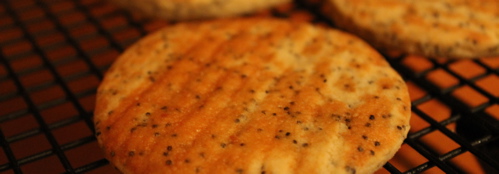
Almond & Poppyseed Shortbread

Inspired by Dan Lepard's Honey & Ginger Wafers in The Handmade Loaf, I've been experimenting. Now, that's not always a good thing but every now and again it creates a corker... 
These buttery shortbread biscuits are light and moist with a textual crunch and nutty poppy seed twist. They've gone down well at home and I'd love to know what you think, if you get a chance to make them too.

(By the way, they're nothing like Dan's wafer triumphs but we all take inspiration from somewhere!)

What you need...
200g plain flour
100g ground almonds
100g caster sugar
1 tsp baking powder
2 dsp poppy seeds
150g cold cubed butter
1 dsp warmed golden syrup

Set oven to gas mark 4

What to do...

Mix all the dry ingredients together and add the cubed butter. Rub it into the mix initially and then gradually kneed it all together to form a light, soft dough.

When all combined, roll out to approx 2mm thickness and cut out rounds. I use a wine glass as there's generally one to hand (?!). Makes approximately 20 biscuits.


Lay the biscuits onto a greased baking sheet and score the top with a fork then brush with warmed golden syrup and bake in the centre of the oven for 15/20 mins - you need to keep an eye to check they don't go too dark and/or that the syrup glaze doesn't burn.
Let them cool slightly before transferring to a cooling rack. And then eat them. All.

Monday, 12 September 2011

The Friday Night Dinner Party Project

This weekend has been busy.

Really, really busy.

Highlights include... parents arriving from France, dinner for 12, foraging for fruit, dancing 'til the small hours, manic house tidy, photoshoot for piece in Daily Mail, waving husband off on windsurfing course, collapsing on sofa. And, to top it all off, got at up five this morning to do the business slot on local BBC radio. 

Bit tired. 

And there's more to come as I now need to make something with the fruits of our forage - I'm thinking a little Elderberry Compote could be in order and have been fantasising about individual blackberry crumbles. Made and frozen now - then revealed in a Blue Peter 'here's one I made earlier' fashion later in the autumn.
 
But, let's go back to The Friday Night Dinner Party Project
We knew we'd have very little time on Friday to get things ready for a sit down meal for 12 - so we kept the menu simple. Soup, cheese and torte. Obviously it still ended up taking much longer than expected and I was slapping on mascara five minutes before people arrived but it was such a lovely evening that it was (always is) worth it.
 
For the soup I went for a favourite Leek and rosemary recipe from Moro East. I love that book. And that's why I wanted to share the bare bones of the recipe - hopefully to give enough inspiration to seek out the real deal from the brilliantly talented Sam & Sam Clark (owners of Moro). 
 
The recipe book follows the stories and recipes of the allotments torn asunder to make way for the Olympics and the incredible edibles that the community grew there. In some ways it's terribly sad and in others it's so inspiring it makes me yearn for an allotment of my own - though the reality of that would be weeds as far as the eye could see and stern words from the allotment committee.
 
The marvellous thing about this soup is that you cook it all and then add the stock. The potato is softened, the leeks are sweet and the blue cheese at the end adds a perfect creamy tangy touch.
 
Without giving away the whole recipe...
 
Trim the leeks (roughly one per person) and slice the white/pale green roots into rounds then roughly chop the darker green leaves and blitz them in a food processor - to waste as little as possible. Soften in butter and olive oil with the lid on then add finely sliced potato (roughly one medium potato for every two people), chopped rosemary, garlic and nutmeg and cook for 20 mins or so without the lid, stirring occasionally.

When it's cooked you can give it a quick blitz so it's as smooth as you like or leave it gorgeously chunky. Add hot vegetable stock (roughly 1/3 litre per person) and return to heat before finishing off with fresh flat leaf parsley.

Finally crumble a blue cheese over the individual bowls, Moro recommend Picos de Europa with Silton or Rocquefort as good substitutes but we went for a Yorkshire Blue as a delicious alternative.


Tuesday, 9 August 2011

Food and love in troubled times...


I had very mixed feelings about writing this blog. There are terrible scenes in our cities, the financial markets are in meltdown. What interest can there be in a frivalous post about food? But then...

I remembered the words of Mr Jonny Wong, a very dear friend (and wonderful cook) who is sadly no longer here. Whenever things got tricky, Jonny would smile and say:
"In with anger, out with love."  
I had wanted to share this recipe because I love it. I think others will love it too. And in troubled times what's better than food and love? 
Involtini – for 4  

This delicious dish is courtesy of Frances, another dear friend, who served it for us last week on my birthday. The weather was kind and we ate outside in lovely company and beautiful surroundings.
It's called Involtini - though I kept thinking I was being offered a hot malted milk drink...

It's a brilliant dish for large groups of people and ideal for vegetarians and coeliacs (just replace the bulgar wheat with quinoa).

Frances served it with griddled asparagus and gorgeous flat roasts. You serve it how you wish!
Henny
xx 
What to do and how to do it
 
To make the tomato sauce... (though you can cheat and buy a jar)

  • 2 tins peeled toms
  • 2 cloves garlic
  • 1 dried chilli
  • 1/2 tsp dried oregano
  • Salt and pepper to taste
Cut finely and fry garlic in olive oil with chilli and oregano. Let soften and then add 2 tins of toms, allow the sauce to cook for 1 hr until the toms start to disintegrate. Set aside.

For involtini...

  • 4 Aubergines
Cut aubergines in 5mm slices lengthways and griddle. Set aside.
  • 100g bulgar wheat or quinoa 
  • 1 tsp dried oregano
  • 50g pistachios, shelled and roughly chopped
  • 200g feta
  • 2 spring onions, finely sliced
  • 1 tbs capers, drained and chopped
1. Cook Quinoa, or put bulgar wheat in a bowl with bowling water. Drain.
2. Mix with all other ingredients
3. Place a teaspoon of mixture on an aubergine slice and roll. Repeat.
4. Place in baking tray, tightly packed together
5. Cover with tom sauce (not too much)
6. Sprinkle with some crumbled feta, pistachios, spring onions (to make it look pretty)
6. Roast in oven for 30-45 mins
7. no need to serve immediately (can be eaten warm rather than hot)

Enjoy xxx 
Happy Birthday to me...

Tuesday, 21 June 2011

Jams and Jellies - or is it Jam and Jerusalem?

The fruits of our labours
Well, it wasn't quite the Women's Institute but there were moments last weekend when I thought I'd passed over into that mythical land of being the perfect wife, mother and pillar of the community. 

But then reality flooded back and I realised it was just a blip on my otherwise blemished reputation.

Willow weaving for the village flower festival, watching friends in the talent show at the Church and dos-a-dos-ing round the marquee on the green. All very Midsomer Murders and, for afficionados of Miranda, such fun! 

And how did we fill the brief pauses between these bucolic activities? By making jam with friends, of course. 

Foraging for Elderflowers, bribing a troupe of small boys to pick more gooseberries and gathering rose petals...bit part in Darling Buds of May, anyone?

Of course, like all these escapades it was worth every moment to have that exciting realisation that the jam has actually set and the jelly is wobbling invitingly.

So, here's the recipe for the Gooseberry & Elderflower Jam. Coming soon... Gooseberry, Elderflower and Rose Jelly. Yum! Can't wait.

Lovers' Knot - made with willow from the river and wild enthusiasm

Gooseberry & elderflower jam
Elderflowers, roses & a Cooking Gorgeous tea-towel


Essential:
1kg gooseberries
1kg sugar
150ml water
15 elderflower heads
Old jam jars sterilised in the dishwasher and warmed through in the oven (so they don't crack when you add the hot jam)

Useful:
Jam pan
Sugar thermometer
Small saucer in the freezer
Wax paper discs

Top and tail the gooseberries and cook them gently in 150ml of water in a large heavy bottomed jam pan. Pop the elderflower heads into the top of the pan - carefully shaking any insects off first. Leave the pan simmering gently for 10 or 15 minutes and remove the flower heads. Add the sugar, allowing it to melt softly into the water and then boil vigorously.

A sticky scum (urgh) will form unless you add a little knob of butter before it boils - or you can just skim off the scum with a slotted spoon.

And wait... until it reaches JAM on your thermometer.

At this point it's really easy to get over excited and decide it's done. BUT! Rush not! First, drop a little onto your ice cold saucer. If it forms a discernible skin that you can push gently with your finger then, and only then, is your jam ready for your jars.

If you haven't got a sugar thermometer and you plan to make jam again, then get one! Until then, you'll have to keep doing the saucer check - it will work.

Carefully spoon or pour the jam into your jars and top off with a wax paper disc and seal tightly. Leave to cool and wash off any sticky residue once the jam has set.


It's a snip

Friday, 3 June 2011

Pasta Puttanesca-esque in 10 minutes

For those lovely moments when you open the fridge and think 'oh God, I really need to go shopping' and then realise... you don't. At least, not yet.


My lovely friend, Loo, was over for a chat that turned into lunch. With vague panic as I looked in the fridge I summoned up thoughts of Spaghetti Alla Puttanesca, that delicious Italian dish so charmingly translated as 'whore's style spaghetti'. Yes, well.

Anyway, obviously I didn't have the ingredients for that either so instead I gathered together things I know work well and started boiling the water. 10 minutes later we sat down to my new creation, which I thought I should share. Loo loved it. Hope you do too.

What you need
  • Enough spaghetti for two people (this varies wildly in our house so I'm shy of specifying amounts)
  • 1 generous tbs tomato purée (I always thought this was a cheat ingredient but it turns out even proper chefs use it. Who knew?!)
  • 6-8 peppadew peppers roughly chopped (I use hot but mild ones work well)
  • 6-8 black olives roughly chopped (particularly good if you've got any marinated ones lurking at the back of the fridge)
  • 1 onion roughly chopped (there's a theme developing here) 
  • 1 clove of garlic (you guessed it) roughly chopped 
  • Toasted pine nuts / fresh basil (optional)

What you do
Start boiling the water for the pasta and get chopping. As soon as the water boils, add your spaghetti with a dash of oil to stop it sticking.

Sauté the onion in olive oil till it starts to soften. Add the garlic, give it a stir then add the tomatoe purée. You'll need to judge the next bit but pour in roughly half a cup of hot water to thin the purée and get it all simmering nicely. You might need a drop or two more, depending on how quickly it evaporates but be careful not to make it too thin.

Next, add the peppers and the olives. If you feel like it, pop in a sprinkling of Bouillon (or half a stock cube) and season to taste. Turn off the heat and throw in your pine nuts and basil.

The pasta should be pretty much al dente by this stage. Strain it but leave a trace of the liquor in the pan. Add the pasta to the sauce - do it this way round so you gather up all the intense flavours from the pan and fully coat the spaghetti. Stir it through and serve.


Wednesday, 27 April 2011

A right royal recipe

Let me introduce you to our guest chef - and her decadent delicious dessert...

Vanessa Kimbell is a chef and food writer with a gorgeous recipe book PREPPED! due to hit the shops later this year.

She is a fabulous supporter of Cooking Gorgeous (and can often be seen sporting her favourite apron - our very own Aubergine Standard, including on one memorable trip to the cinema!) Vanessa has kindly offered up one of her trademark dishes to kick off our new recipe series: Notes from a Kitchen Island.

I hope you love making it - and that you love eating it even more.

With love,
Henny

PS: It's a British classic with a touch of spice - a perfect partner to a right royal weekend!


Star Anise & Orange Bread Pudding
I don’t suppose we often think of bread pudding as a glamorous dish, but this is a seriously gorgeous desert that is met with delight in our house. The star anise gives a delightful twist and the bitter orange marmalade tempers the sweetness while the eggs and cream form a deliciously smooth custard.

To make your own bread to use in this recipe, I highly recommend the Milk Loaf from 'The Handmade Loaf' by Dan Lepard. An artisan baker extraordinaire.

The pudding generously serves 10 - 12, but we eat it over 2 - 3 days. I sent part of this one back with my photographer Nicky Callis - it was the least I could do to thank her for these lovely photos!

Vanessa
x

And here's how to make it...

Serves 10 - 12
Prep time 20 minutes
Cooking time 1 hour 20
Freezes No
Size of dish 9cm deep, 32cm long and 27cm wide 775g of white tin loaf

275g raisins
140g caster sugar
Zest of 1 orange
1.5l of whole milk
600ml single cream
8 medium eggs
7 star anise
3 or 4 tbs of orange marmalade


1 Preheat the oven to 180 (between gas mark 4 and 5).  Slice the bread into 1.5 cm slices.
 

2 Arrange the slices in a large deep dish, scattering the raisins and sugar evenly between each layer. You will get about 3 layers or so depending on the thickness of your slices. Keep 3 or 4 spoons of sugar in reserve to use later on. Bear in mind you need to leave a little room at the top, as the pudding will rise as it cooks.

3 Evenly distribute the orange zest over the top of the pudding.

4 Pour the milk, cream and eggs in a jug and whisk to evenly distribute the egg.

5 Pour gently over the bread and using the tips of your fingers gently press into the bread to ensure the liquid is distributed throughout.

6 Sprinkle on the remaining sugar and scatter the Star Anise over the top. Pop into the oven. After an hour and 20 minutes check that the pudding is risen and golden. If it's not golden, cook for a further 10 minutes and check again.

7 Remove from the oven and discard the Star Anise before glazing. To glaze, gently spoon 3 - 4 tablespoons of marmalade over the pudding whilst it's still hot.

8 Serve hot or cold with custard or cream.

For more information about Vanessa Kimbell’s forthcoming recipe book go to www.prepped.co.uk


With very many thanks to the lovely Vanessa Kimbell (and apologies to Bill Bryson).


Tuesday, 8 March 2011

Elderberry Compote (also known as jam that hasn't set)

It is Shrove Tuesday 2011 and after twittering to others about how delicious my elderberry compote is on pancakes, I am inspired to put fingers to keys and share the recipe.

Delicious, almost free, long-lasting and SO easy to make! And, unlike my many other attempts at creating the perfect preserve, is always a resounding success. The secret being that it's not meant to set so it can't ever go wrong. I love recipes like that.

Obviously now is completely the wrong time of year to be out gathering elderberries but maybe the recipe below will spark a little thought when you next see those tantalising juicy berries hanging from the trees.


How to make your elderberry compote...

Gather as many berries as you can carry - but always leave some for the birds. I hate to see trees that have been stripped bare of their provinder. And make sure the berries in the bunches are ripe - it's disappointing to get home thinking you've got a great haul only to find that too many of them green and unusable (and it feels awful knowing they're wasted).

Once home, gently prise the berries from the stalks with your fingers. You can use a fork to tease them off but I've found that leads to too many stalks landing in the bowl - though that could just be me. Don't get too precious about the whole thing - it's meant to be easy and relaxed.

Next, give them a rinse and pop them in a heavy bottomed jam pan with approx equal amounts of sugar (or a bit less if you're feeling virtuous). DON'T panic that it looks too dry! The water on the berries will create enough liquid and if you add any more it will be too runny (I've done this several times and always regretted it. Restraint! Restraint!).

Check the temperature with a jam thermometer if you have one, or do the old saucer in the freezer trick (drop a little of the gooey liquid onto a very cold saucer, if it clings to the surface it's probably done). Remember it won't set (mine never has anyway!) but if you follow basic jam making principles it will work. Get it bubbling away with all the sugar disolved and smelling gorgeous. 
Pop it into jars that have been sterilised in the dishwasher (lazy but good option) and then heated through in a low oven so they don't shatter when you add the compote. Seal with wax discs and jar lids and label up.

Gorgeous & delicious!

How to use your elderberry compote...

You can use the compote in very many ways too...

Marbelled through whipped cream and served with homemade meringue is one of my favourites or, of course, today being Shrove Tuesday, served on hot fresh pancakes... mmmmmmmmm.

Wednesday, 16 February 2011

Help me, I'm a vegetarian

Artisan hand-reared pork sausages served in a red wine jus with creamy potatoes. AKA bangers & mash.

One of my favourite meals and the dish we've decided to serve every Christmas day from now on.

The decision came after yet another 25th December involving frantic sweaty hours in the kitchen dangerously festooned with ribbons and bows from the prezzies of generous gift giving rellies, followed by a table groaning with a collection of dishes that we never normally eat. Enough. No more sad dry Turkey (for me, sad dry nut something) undercooked roasts and overcooked brussells. Bangers & mash is the way forward.

I need to be honest here. This isn't me or my kitchen.
But the model is wearing a CG apron and using the
CG Chef's Cloth - both critical elements of this recipe!
But how to cook it? And what am I, 20-years a vegetarian, doing writing down a recipe for a dish involving dead animals? Well, I think it's ok as long as the pigs were happy.

If I hadn't been veggie for so long (and if we had enough acerage for a small holding, and someone else chose who was going for slaughter,  and I never actually had to look the little piggies in the eye knowing they were going to demise) then, maybe, I'd actually eat the stuff myself... Who am I kidding? That's never going to happen. But I'm not a fascist and I'm quite happy to share a dinner table with people who do. As long as you don't put your fork anywhere near anything that's going on my plate.

So, how to do it? I've created the following myself - I think. If I've inadvertently stolen the idea from another recipe I read many moons back then I can only apologise. But, it's so rough and ready that I'm pretty sure no self-respecting chef is going to try and claim it.

I've tried it out on numerous guests (as I said, it is one of our favourite meals) and it works equally well with veggie sausages - Quorn seem to work best. Not sure why as they're not my favourite veggie bangers but there you go.

You'll need...
  • Enough sausages - happy/organic/veggie - to feed your guests
  • Lots of potato for the mash + plenty of butter
  • A bottle of decent red wine - cheap stuff really doesn't work. We've tried.
  • Some sage - a couple of sprigs will do
  • Bouillon
  • Bisto gravy granuals (I said it was rough and ready)
  • Couple of decent sized onions - softened in butter and olive oil with half a spoonful of brown sugar
  • 1 large savoy cabbage - finely shredded and cooked in a big pan with olive oil, butter, a pinch of good chilli flakes, salt, pepper and a couple of cloves of garlic
What to do...

Brown the sausages in a large roasting pan on top of the hob. The pan should comfortably hold the sausages but not so they're looking lonely and forlorn. When they're nicely coloured (but not cooked through), pour in the red wine so they're more or less submerged. Add a sprinkling of bouillon and the sage - I sometimes throw in a couple of bay leaves too. Not sure if they add anything but I just like going to get them from the garden.

Bung the pan in the oven at about gas mark 5 for half-an-hour to 40 minutes. You'll know they're ready when the wine has reduced and thickened. The joy about this dish is that you can leave it for longer if your guests are late or you forget you're meant to be doing the lunch.

Meanwhile make the mash, the onions and the cabbage. I generally put the mash in an oven dish and stick it in the bottom of the oven. 

Remove the sausages from the now thickened jus and pop them back in the cooling oven with your plates to keep warm. Quickly heat through the cabbage and onions that you've already prepared and stir some gravy granuals (I know, I know, it's so low brow) into the red wine. Season to taste. And Bob, as they say, is your uncle.

Disclaimer...

You'll need to trust your instincts with this recipe - it's definitely not Delia's sure fire moment by moment approach but it does work and it will taste scrummy.